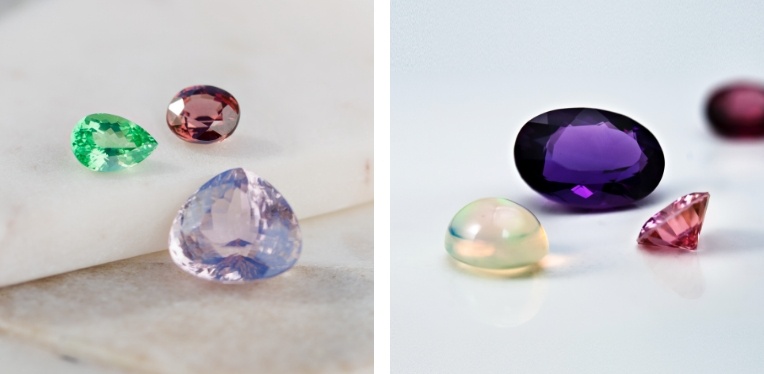
SAPPHIRE FANCY
| SAPPHIRE | September's birthstone |
| Major Sources | Australia, Cambodia, China, Kenya, Madagascar, Nigeria, Sri Lanka, Tanzania, Thailand & Vietnam |
| Colors Found | Various |
| Family | Corundum: Al2O3 |
| Hardness | 9 |
| Refractive Index | 1.76–1.78; Uniaxial (–) |
| Specific Gravity | 3.97–4.05 |
| Crystal System | Trigonal |
| Enhancements | May be enhanced |
Since the dawn of time, sapphires have captivated and mesmerized jewelry connoisseurs the world over. From hot pink to forest green, sapphire’s spectrum of colors is truly kaleidoscopic.
Fancy sapphires get their unique colors from the iron, chromium, titanium and other trace metals present within the corundum, along with color centers.
Chanthaburi sapphire (Thailand)
Black star sapphires are found mainly at Bang Kha Cha and Khao Ploi Waen, Chanthaburi (approx. 152 miles east of Bangkok. From these mines, just a few miles from the GemsTV workshops, stunning blue, green and yellow sapphires are also unearthed. Displaying gorgeous golden hues, a stunning sapphire variety we aptly called “Chanthaburi sapphire” from a new alluvial pocket at Bang Kha Cha proved hugely popular in 2005.
Black star sapphires differ from other corundum in that their color is not due to trace elements or color centers. Instead, it is caused by the color of exsolved hematite-ilmenite silk inclusions. This silk imparts a deep brown black color to an otherwise blue, green or yellow sapphire. This is called mechanical coloration or “color by inclusions.” Not only are they responsible for color, but they also produce a six-rayed star effect. When it occurs in an otherwise blue or green sapphire, the rays of the star appear white. Sometimes the hematite unmixes in a yellow sapphire, giving the star a golden yellow color.
Today, mining in Chanthaburi is limited making top quality sapphires from this town exceedingly rare. In fact, we think what is being traded in the local market is predominately older stock, with very few new gems being unearthed.
Color change sapphire
While color change sapphires come from a variety of locations, the gem gravels of Tanzania are the main source. Color change sapphires present gem lovers with an opportunity to own the rare and stunning color change effect in a gem other than alexandrite or garnet. While the colors tend to vary depending on locale, in general they change from khaki green to reddish purple. The picture of a notable exception from Sri Lanka, changing from purple to red, is included below.
Green sapphire
Green sapphires display a range of green hues, from tropical limes to wine bottle greens.
Padparadscha & padparadscha color sapphire
While sapphires have mesmerized jewelry connoisseurs since the dawn of time, there is one sapphire variety that attracts above all others, the mysterious and coveted padparadscha sapphire.
The padparadscha derives its name from its resemblance to the beautiful and famed lotus flower (nelumbo nucifera speciosa).
Padparadscha sapphires must combine elements of pink and orange in one gem to rightly claim their padparadscha title. One way to picture the color of padparadscha sapphires is to imagine sitting in front of a lazy fire on an isolated beach painted by the soothing hues of a tropical sunset. You then hold a fragrant lotus bloom to your nose and at that instant, the colors meld creating an aurora of orange and pink. This is padparadscha.
Wonderfully romantic and delightfully seductive, padparadscha sapphires are so rare and beautiful that they are highly prized by collectors. But what are the origins of the word padparadscha?
Often misunderstood, the modern word padparadscha was in fact adopted from a German gemological text early in the 20th century. The word padparadscha is actually a corruption of two Sanskrit and Sinhalese words padma and raga. While padma means lotus, the word raga is more complex, meaning color, attraction, desire and musical rhythm all in rolled into one.
Interestingly, the original term had much broader applications and was even used in ancient times to describe a variety of ruby. Thakkura Pheru’s medieval Prakit text on gemology, Rayanaparikkha, describes padparadscha sapphires as “that which spreads its rays like the sun, is glossy, soft to the touch, resembling the fire, like molten gold and not worn off is Padma Raga.” Identical in appearance to padparadscha sapphires, padparadscha color sapphires are artificially colored sapphires creating by adding beryllium during heat treatment.
Although the exact description is often debated, the beauty of these rare gemstones is not. While some continue to narrowly define padparadscha as a Sri Lankan sapphire, today padparadschas also hail from Madagascar, Vietnam and Tanzania. Regardless of the locale, padparadscha sapphires, especially in larger sizes, are among the rarest and most valuable members of the corundum family.
Pink sapphire
Immensely popular, pink sapphires range from pastel to vivacious pinks and share a color border with ruby. Some pink sapphires are so close to this boundary they are called “hot pink.” Sharing exactly the same position on the color wheel, red and pink are technically the same color. It is the saturation or strength of this red hue that differentiates red from pink. The problem is that the border region where pink stops and red starts is open to interpretation. Despite numerous attempts by various trade groups, the controversy still rages.
Purple/violet sapphire
Highly prized by collectors, purple/violet sapphires (also once known as oriental amethyst) can display rich purple to violet-pink colors reminiscent of orchids.
Yellow sapphire
Ranging from pleasing pastel daisies to intensely beautiful canary yellows, yellow sapphires are renowned for their amazing luster and brilliance. Yellow sapphires are not just beautiful, but are also one of the most coveted of all yellow gemstones. In addition to occuring naturally, they may also be artificially colored by adding beryllium during heat treatment.
Star sapphire
With their very bright and lustrous star formations, star sapphires have traditionally been the most popular of all star gemstones. Glance at a star sapphire and you will see six or even twelve rayed stars silently gliding across the gemstone’s surface. This wonderful gem has long been coveted for its beautiful and mysterious optical effect known as asterism. “Asterism” or the “star effect” is caused by sets of parallel needle-like inclusions within the gemstone. While the gem gravels of Sri Lanka and Burma are the world’s main sources of star sapphires, black star sapphires are mainly found in Thailand’s Chanthaburi province and in Australia.
In many cultures star sapphires were considered love charms; Helen of Troy was said to have owned a star sapphire and to have owed her conquests to it. In 17th century Germany, star sapphires were the siegstein, meaning “victory stone.” To others, star sapphires were the “stone of destiny,” as their crossing bands of light were believed to represent faith, hope and destiny.
Star sapphires were commonly used as talismans to protect against the evil eye and the Sinhalese used them to guard against witchcraft. Star sapphires were particularly prized in ancient times as a guiding star for travelers. The famous English traveler, Sir Richard Francis Burton, possessed a large specimen which he referred to as his talisman, claiming it brought him good horses and prompt attention wherever he went. In fact, it was only in those places where he received proper attention that he would show it, a favor greatly appreciated because the sight of the gem was believed to bring good luck. One of the most unique of all talismanic gems, star sapphires are said to be so potent that they continue to exercise their good influence over the first wearer even if it has passed into other hands.
Sunset sapphire
While it might not have the pinks to be padparadscha, there is nothing about the beauty of sunset sapphires that is lacking. Displaying a bright blend of crimson tangerines reminiscent of an African sunset, sunset sapphire (also called Songea sapphire) was only discovered in 1992. The world’s only sunset sapphire deposit is located 37 miles west of Songea, with the Masuguru district being the main mining area. Discoveries like sunset sapphire have helped Songea become the second most important Tanzanian mining area after Merelani (the home of tanzanite). In addition to occuring naturally, they may also be artificially colored by adding beryllium during heat treatment.
White sapphire
The ancient Egyptians associated white sapphire with the all-seeing eye of Horus, while the Greeks linked it to their god Apollo, using it in the prophesying of the oracles at Delphi.
The ancient Greeks unearthed white sapphires from the island of Naxos in the Aegean Sea.
With none of the iron, chromium, titanium and other trace elements that give sapphires their unique colors, white sapphire is arguably sapphire in its purest form. Displaying an exceptional luster and brilliance, it has become a popular alternative to diamonds.
|
|
||||||
|
|
||||||